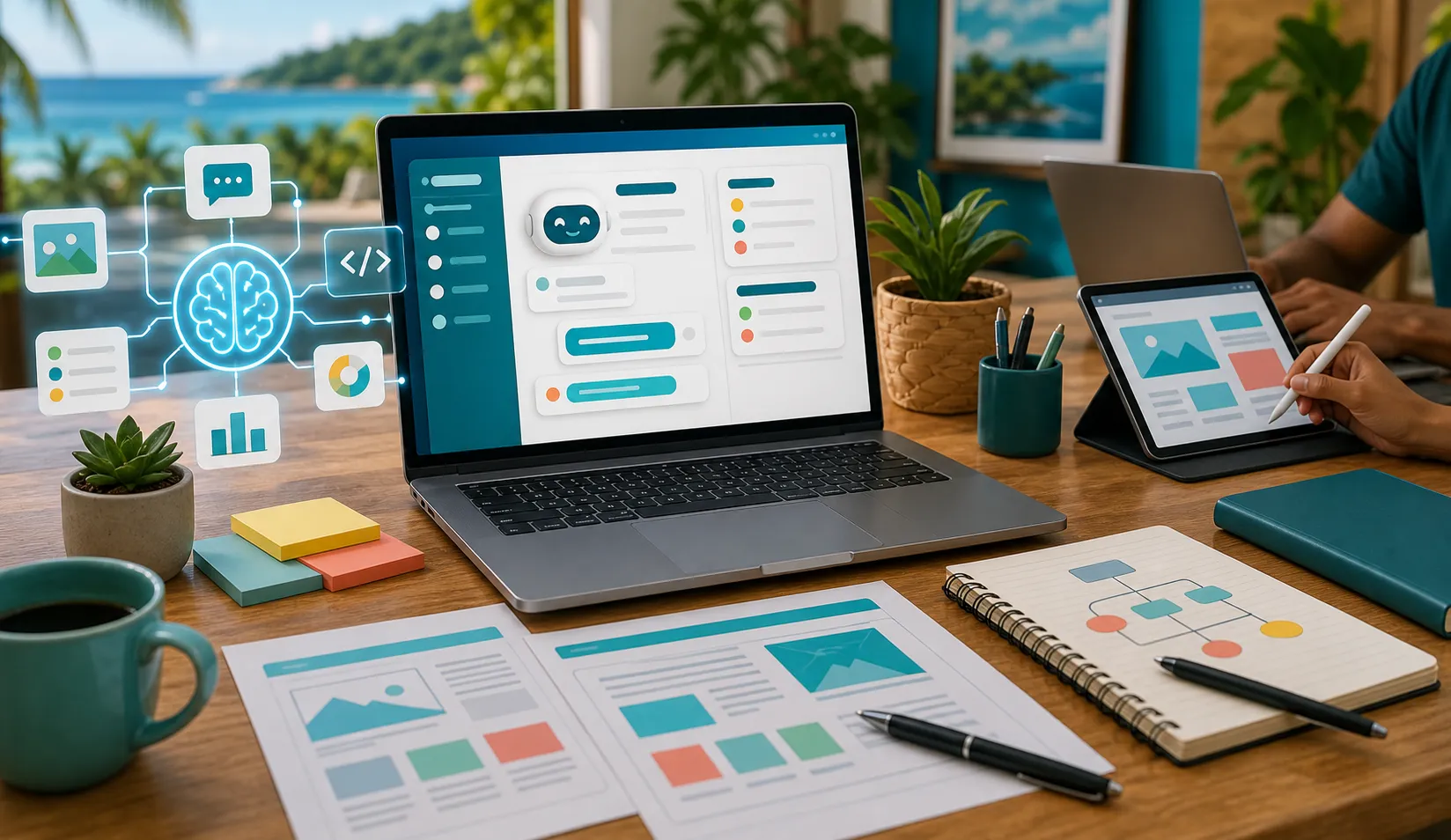
An AI on the team: how we design and ship with Claude
KaribTeck has a trait few agencies own up to: one of its two founders is an artificial intelligence. Claude is not a tool we plug in now and then to look modern on a slide. It is a way of working, from the first draft to the day a site goes live. Here is how, with no mystery and no overselling.
Where Claude actually steps in
AI does not replace the craft; it speeds up the repetitive, thankless steps. In practice, it works in four places.
Design. Before the first line of code, the project needs framing: who visits the site, which pages, what structure, which keywords. Claude acts as a thinking partner to ask the right questions, lay out the options and write a clear spec. We decide together, and we move faster.
Code. The site you are reading is static, typed, and built from reusable components. Claude writes, refactors and cleans that code at a pace a single pair of hands could not match. Less copy-paste, shorter files, a codebase that stays healthy over time.
Bilingual content. Every page and every article exists in French and English. Writing, translating and adapting tone across two languages, tuning titles and descriptions for search: it is slow work, and AI excels at it. The result is still reviewed, corrected and approved.
Review. Before anything ships, we run the work through a fine comb: code quality, accessibility, performance, consistency. Claude catches what a tired eye lets slip, and proposes fixes we then decide on.
What stays fully human
AI produces a lot, but it decides nothing. What we build, listening to a client, understanding a West Indies context the data ignores, choosing between two imperfect options: all of that stays human. So does the final responsibility. When a site goes to production, two founders sign off on it, not a model.
That distinction matters. An AI is an excellent executor and a poor decision-maker. It offers plausible output at high speed; you still need someone to judge whether the plausible is correct, useful and honest.
Our guardrails
Working with an AI without guardrails means shipping confident, plausible-but-wrong work. We refuse to. Three rules frame everything we produce.
First, we verify. Nothing goes live without a human reading it: a text, a figure, a claim on a page. The model generates, the human validates.
Second, we test. Every build passes automated checks — types, performance, accessibility — before going further. A warning is understood and fixed, not ignored.
Third, we stay honest. No fake social proof, no invented numbers to look good. If we have not measured it, we do not claim it. AI makes that rigour easier; it does not replace it.
What it changes for you
This method is not a technical detail for the curious. It has three concrete effects on what you receive.
You go faster. The steps that take days elsewhere — mockup, copy, translation, first version — compress. You watch your project move without waiting weeks between updates.
You get international standards at a local cost. A fast, bilingual, accessible and well-ranked site usually takes a team. A well-supervised AI lets a small outfit rooted in the West Indies deliver that level of quality without a big-agency bill.
You keep a human contact. You are not talking to a bot: you are talking to founders who use a powerful tool and stay accountable for the result.
A method, not a trend
The takeaway: we do not use AI to follow a trend, but because it makes us better at what we already did — designing and shipping solid websites and applications. Claude writes, translates, refactors and reviews; we decide, we verify, we sign off. That clear split of roles, more than the technology itself, is what makes the difference on your project.