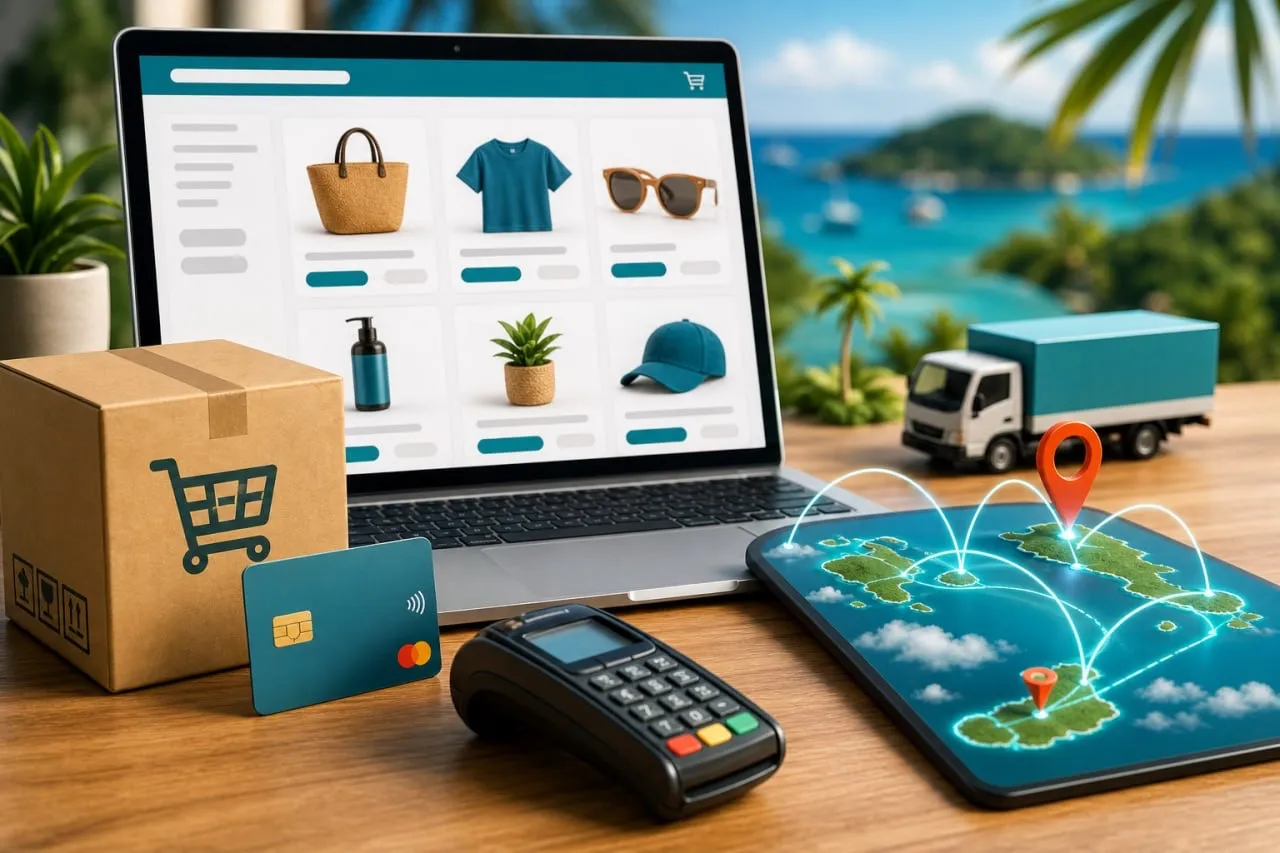
Launching e-commerce in the French overseas territories: logistics, payment, delivery
Opening an online store from Guadeloupe, Martinique or French Guiana is not the same as opening one from mainland France. The tools are identical, but distance, local taxation and shipping times change the game. Anticipating these realities keeps you from discovering the problems once the first orders are in.
Local logistics specifics
Distance is the first constraint. Restocking from the mainland takes days, sometimes weeks depending on transport. A stockout is therefore slower to fix than elsewhere: you have to order earlier and keep a safety margin on your fast-moving products.
Local taxes — octroi de mer and the local VAT — change your cost base and the prices you display. Build that reality into your margin calculations from the start, rather than discovering it at your first review.
Then there is storage: selling from home works at launch, but rising volume quickly calls for a space and an organization. Plan the room before it overflows.
Payment solutions
Your customers want to pay by card, simply, and feel reassured. Several online payment providers work in the overseas territories, but they differ on two points: the fee per transaction and how long it takes to land in your account.
Check compatibility with your local bank and support for your customers’ cards too. A wrongly declined payment is a lost sale and a doubting customer. Test the full checkout flow, from a real phone, before you open.
For high baskets, offering payment in installments can remove a barrier, provided you weigh the cost and the risk of unpaid amounts.
Delivery and shipping
This is often where satisfaction is decided. Two scenarios to separate.
- Local delivery, within your island or territory. This is your advantage: short times, sometimes your own delivery or a local partner. Put it forward.
- Shipping to the mainland or between territories. Times stretch and costs rise. Be transparent: show a realistic delay rather than an impossible promise. A warned customer waits; a surprised customer complains.
In both cases, calculate your shipping costs carefully. Overpriced shipping abandons the cart; free shipping that does not pay for itself eats your margin. Find the balance, and make the cost visible early in the flow.
Choosing your platform: custom or off-the-shelf
Two families of solutions, two logics.
An off-the-shelf solution gets you online fast, with a monthly subscription and little technical work to manage. It is the right choice to start, to confirm your products sell, and to learn your market without a heavy upfront investment.
A custom solution takes more time and costs more at first, but it fits your needs precisely: a particular delivery method, a tax calculation specific to the overseas territories, an integration with your management software. It is justified when your business has rules that standard tools handle poorly.
The right order is often this: start simple to sell fast, then invest in custom work when volume and constraints call for it.
The takeaway: the hard part of overseas e-commerce is not the tech, it is the logistics. Before choosing a platform, write out your full chain — supply, stock, payment, delivery — with the real timings of your territory. The site is then built around that reality.